
Eagle Mountain Previous-Resident Sources
Use a source for the fact it can actually show. The previous residents of an Eagle Mountain address will not appear in every source. Deeds and recorder indexes identify parties and legal descriptions. Directories place a listed person at an address for an edition. A census supplies household relationships for a released year. Newspapers add moves, deaths, sales, and public notices. Probate can name heirs or an executor. A parcel map shows geometry, not a household.
| Source | Years or window | Where held | What it shows |
|---|---|---|---|
| Utah County official records | 1870-present | Recorder online, books, microfilm | Deeds, liens, plats, legal descriptions |
| Computerized recorder index | January 1978-present | Recorder online | Party-name retrieval |
| FamilySearch Utah County | 1850-1962; deeds 1870-1931 | FamilySearch and county originals | Selected land, vital, marriage, mining, and related books |
| Provo/Utah County directories | 1867, 1879-80, 1904-05, 1911-1922 and later leads | FamilySearch, U. Utah, libraries | Listed occupants, addresses, occupations |
| Federal census | Latest public release 1950 | NARA, FamilySearch, libraries | Household relationships and place |
| Newspapers and probate | Collection-specific | UDN, courts, libraries | Obituaries, heirs, notices, moves |
This table is an era map, not a promise of complete coverage. The older the address, the more likely the source uses a county or predecessor-place label.
Open the FamilySearch Utah County collection for the most specific digitized county starting point. The collection contains 15,657 records, 45,194 personas, and 105,474 images according to the research capture, with an account possibly needed for images.
The collection is valuable for predecessor context, but it is selected historical material, not a complete modern title chain.
Eagle Mountain Address Parcel Start
Search the present address in Utah County Land Records or the Parcel Map. Record the parcel serial, current owner field, situs and mailing addresses, alternate address, acreage, lot, plat, phase, tax area, valuation row, and document link. The inspected Eagle Mountain sample uses serial 34:707:0809 and shows 9781 N Belle St, an alternate 1196 E Haviture Way, and a lot in Arrival Phase B.
The current owner is an index starting point. A search for previous residents should treat that name as the first row, not the final answer. It does not identify every household member or prove continuous residence. If the parcel has an LLC, trust, or title-company party, follow that entity into Commerce and the recorded instrument rather than treating the entity as a resident.
Trace the Eagle Mountain Deed Chain
Open the parcel’s Documents table and begin with the latest conveyance. Separate entry number, instrument date, recording date, type, grantor, grantee, and legal description. The sample includes warranty deeds, trust deeds, releases, subdivision plats, and correction-style rows. Only some rows transfer title.
- Capture the current serial, legal description, and latest deed entry.
- Read the grantor, grantee, date, document type, and image or detail link.
- Search that grantor as an earlier grantee using the legal description and date.
- Repeat backward, keeping releases, liens, easements, and trust deeds in their own roles.
- Use the recorder counter, books, microfilm, and FamilySearch when the online index ends.
Utah County official records begin in 1870. The handwritten alphabetical index runs through January 1978; the computerized index begins in January 1978. Recorded images are described as free online. Office copies cost $1 per page, certified copies add $5, ownership plats cost $2, and official subdivision plats cost $4.
- Grantor
- The party conveying or giving an interest in an instrument.
- Grantee
- The party receiving an interest named in the instrument.
- Chain of title
- A sequence of recorded transfers tied by party and legal description.
- Legal description
- The lot, plat, phase, or land wording that identifies the parcel more reliably than a changed street number.
Use the Utah County Recorder guide for the office search and copy route. The Recorder does not conduct title research by telephone or provide legal advice.
Eagle Mountain Index Break
For records before January 1978, a name search may require handwritten alphabetical indexes, deed books, microfilm, abstract records, or a counter request. Abstract records are listed as handwritten or typed from 1870 through September 1985 and computerized from May 1980 forward, so the published date ranges overlap.
Search the grantor and grantee, not only the current owner. Test spelling, initials, married names, entity names, and the legal description. A party may appear in an easement or release without owning the house. A subdivision plat may create the lot key without naming an occupant.
Eagle Mountain Deed Images
FamilySearch’s Utah County collection provides a historical bridge for selected land books and indexes. Research identifies deeds from 1870-1931 and a deed index from 1870-1894, plus other county series through 1962. The original material is connected to Utah County records channels, including the Records Center in Spanish Fork for some images.
Search a name, place, event, or legal description, then compare the image with the catalog label. Do not assume that a digitized series includes every parcel or every page. Keep the image, book, page, record role, and confidence note with the row.
Eagle Mountain Past Households
Owners are only one layer of previous residents. The next previous residents clue may come from a directory, census, or notice. Regional Provo and Utah County city directories can show a listed occupant, spouse notation, occupation, and address for a particular year. The volumes identified include 1904-05, 1911, 1913-14, 1915-16, 1917-18, 1920, and 1922, plus other discontinuous Provo years.
Use the name section, then the street section. Pair a directory year with the nearest released census. If a person disappears, test a move, death, nonlisting, or missing volume. The Eagle Mountain city directory guide covers the collections themselves, while this page uses them as one link in an address history.
- Write the address and name exactly as printed.
- Check the street section and nearby listed households.
- Pair the edition with the closest census year.
- Search newspapers, cemetery records, or probate for a dated change.
- Return to the deed chain and keep uncertain rows unresolved.
Lawful use. Previous-resident research is for house history, family history, and personal curiosity. Do not use an old address to stalk, harass, track, intimidate, or harm a living person.
Eagle Mountain City Files
Eagle Mountain planning and building pages identify OpenGov applications and permit types. A complete public address history was not located. Request a specific permit, certificate of occupancy, inspection, agenda, or development agreement through the city when the online material does not answer the date question.
Residential building plans have a special limit in the city GRAMA form: they are copyrighted, view-only in the Recorder’s Office for one year after certificate of occupancy, and then destroyed. Metadata can survive after a plan copy does not. A permit applicant also is not automatically the owner or occupant.
Use the Eagle Mountain GRAMA form to describe an existing record by address, parcel, date, or project.
Eagle Mountain Sanborn Maps
The Library of Congress Sanborn guide says public-domain maps are digitized except some 1923-1930 sheets, and its advanced search covers the Geography and Map Division collection. No Eagle Mountain sheet was located. Search Eagle Mountain, Cedar Valley, Lehi, and Provo separately because older maps are more likely to show predecessor towns.
A Sanborn map may show a building footprint, material, use, and nearby street context. It does not supply a complete previous-resident list. Use a map to test whether a structure or street existed, then return to deeds, directories, newspapers, and city files.
Read the Library of Congress Sanborn search guide before treating a missing sheet as proof that no building existed.
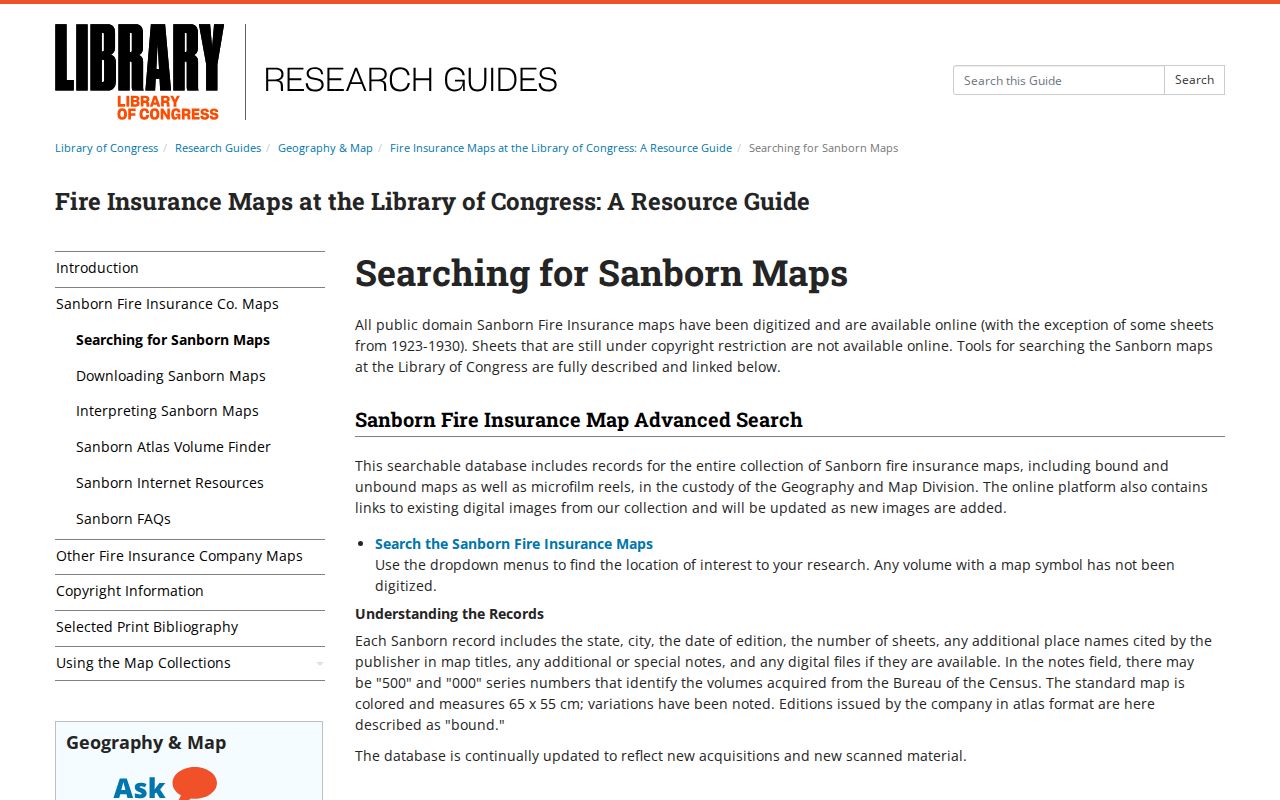
The guide supports a careful map search, especially where the modern city name is newer than the map collection.
Eagle Mountain Obituaries and Probate
An obituary can name a spouse, children, funeral home, church, military service, former address, and move timing. Probate can name an executor, administrator, heir, guardian, or final address. Utah District Court records and the Fourth District probate index are the court-side routes.
Use Utah Digital Newspapers, FamilySearch, cemetery records, and Xchange together. A dated obituary can explain why an owner disappeared from a directory. A deed after death can connect probate to the property. A name in one source remains a lead until a second anchor agrees.
Eagle Mountain ZIP History
The previous residents trail can cross postal labels. USPS moved 3,058 deliveries from legacy ZIP 84043 to Eagle Mountain 84005 in 2006. Search both last-line labels in newspapers, directory scans, tax notices, and family papers. Also test Eagle Mtn, Cedar Valley, Lehi, Saratoga Springs, and Utah County.
The address-continuity worksheet should carry source title, exact date, printed address, serial or legal description, person or entity, role, image or page, and confidence. Require two anchors, such as street plus spouse or plat plus grantor, before joining a historical row.
Eagle Mountain House History Log
Use one row for each deed, directory listing, census entry, obituary, probate file, permit clue, or map. Record the exact source title, date, printed address, serial or legal description, person or entity, role, image or page, and confidence. Keep an owner, occupant, grantor, grantee, applicant, and mailing recipient in separate columns.
When two sources disagree, preserve both entries and note the conflict. A clean chain is not the goal. A traceable chain is. This log also makes it easier to hand a focused question to the Recorder, Provo City Library, FamilySearch, the State Archives, or the city records office.
Eagle Mountain Trail Limits
A previous-residents search may end because a directory volume is missing, a record is private, a name is too common, or a parcel was not yet assigned its current street number. Those are normal limits in Eagle Mountain’s young city and fast subdivision history.
Mark the gap instead of filling it with an assumption. A public record request can seek an existing document, but it cannot make a custodian create a profile. A historical lead is still useful when its uncertainty is labeled.